Budjit: from family budget to household operating system
A modular household platform that turns fragmented financial and family routines into one secure, decision-focused workspace.
Project overview
Budjit began with a focused question: how can a household understand
its money without turning everyday financial management into another
full-time job?

The answer grew beyond a traditional budget tracker. Household finances
are connected to bills, schedules, goals, chores, documents, meals,
maintenance, reminders, and the people responsible for each decision.
Budjit is being developed as a modular household operating platform that
brings those related responsibilities into one calm, coherent system.
The product goal is not to show more data. It is to help a household
understand what needs attention, why it matters, and what to do next.
The challenge
Household information is usually scattered across bank websites,
spreadsheets, calendars, paper notes, messaging apps, and memory. Each
tool may work on its own, but the overall experience creates recurring
friction:
- Financial totals lack context or a clear next action
- Bills, goals, and schedules live in disconnected systems
- One person often carries most of the household's organizational load
- Generic finance tools rarely reflect how a real family shares work
- Sensitive information needs stronger boundaries than an ordinary productivity app
- Adding every possible feature to one codebase quickly becomes difficult to maintain
The design problem was therefore both technical and human: create a
system broad enough to reflect real household life, but structured
enough to remain understandable, secure, and adaptable.
Product strategy
Budjit uses a stable financial and household core surrounded by optional
capability modules. The core owns the primitives that every important
workflow depends on: authentication, households, membership, roles,
authorization, accounts, budgets, income, and expenses.
Features that a household may not need every day can be delivered as
plugins. This keeps the primary experience focused while allowing the
product to grow into a larger ecosystem.
Core responsibilities
- Secure authentication and session handling
- Household membership and role resolution
- Household-scoped data access
- Accounts, budgets, income, and expenses
- Shared navigation and design foundations
- Authorization and CSRF enforcement
Expandable capability areas
- Recurring bills and subscriptions
- Debt payoff planning
- Net-worth tracking
- Calendar and reminders
- Household tasks and chores
- Private household messaging
- Meals, groceries, and pantry planning
- Home and vehicle maintenance
- Documents and shared records
- AI-assisted financial guidance
Designing for decisions
Early financial software often stops at totals and charts. Budjit treats
those as evidence, not the final answer. Its redesigned surfaces lead
with interpretation and action:
- What is happening? A concise status or change summary.
- Why does it matter? Context, comparison, or risk.
- What should happen next? A focused recommendation or workflow.
- Where can I investigate? Supporting detail for users who need it.
This pattern now shapes the dashboard, analytics, accounts, spending
habits, predictive budgeting, debt planning, net worth, and Financial
Health experience.
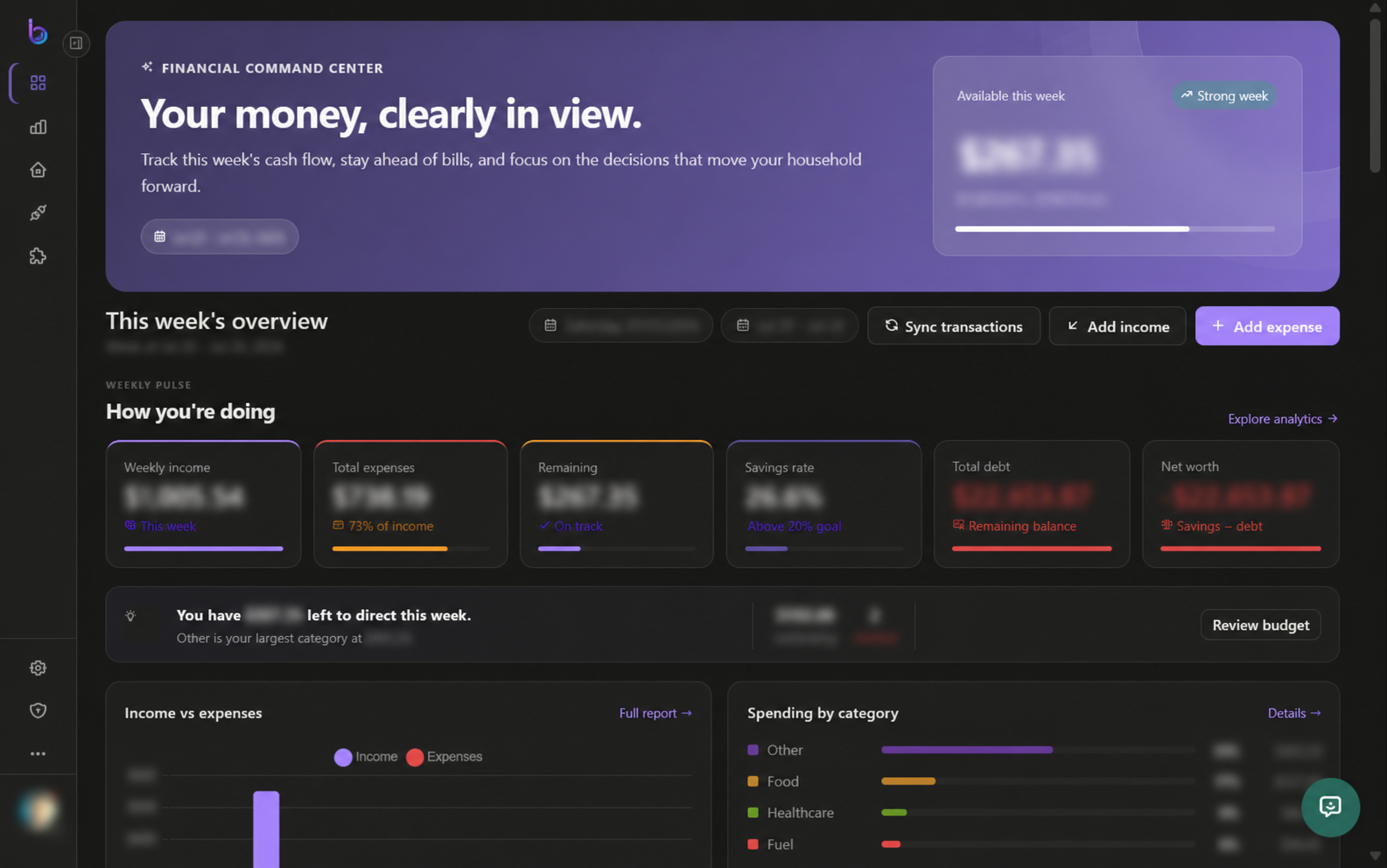
The dashboard turns financial activity into a focused weekly briefing. Private values have been blurred.
Financial Health
The Financial Health workspace combines five signals:
- Savings rate
- Debt-to-income ratio
- Emergency-fund coverage
- Budget adherence
- Spending stability
Missing information is excluded rather than treated as failure. The
remaining weights are normalized so a household is not unfairly scored
at zero simply because a component is unavailable. Daily snapshots make
the result useful as a trend, while recommendations translate the score
into practical next steps.
This approach reflects a broader product principle: incomplete data
should be communicated honestly, not converted into false precision.
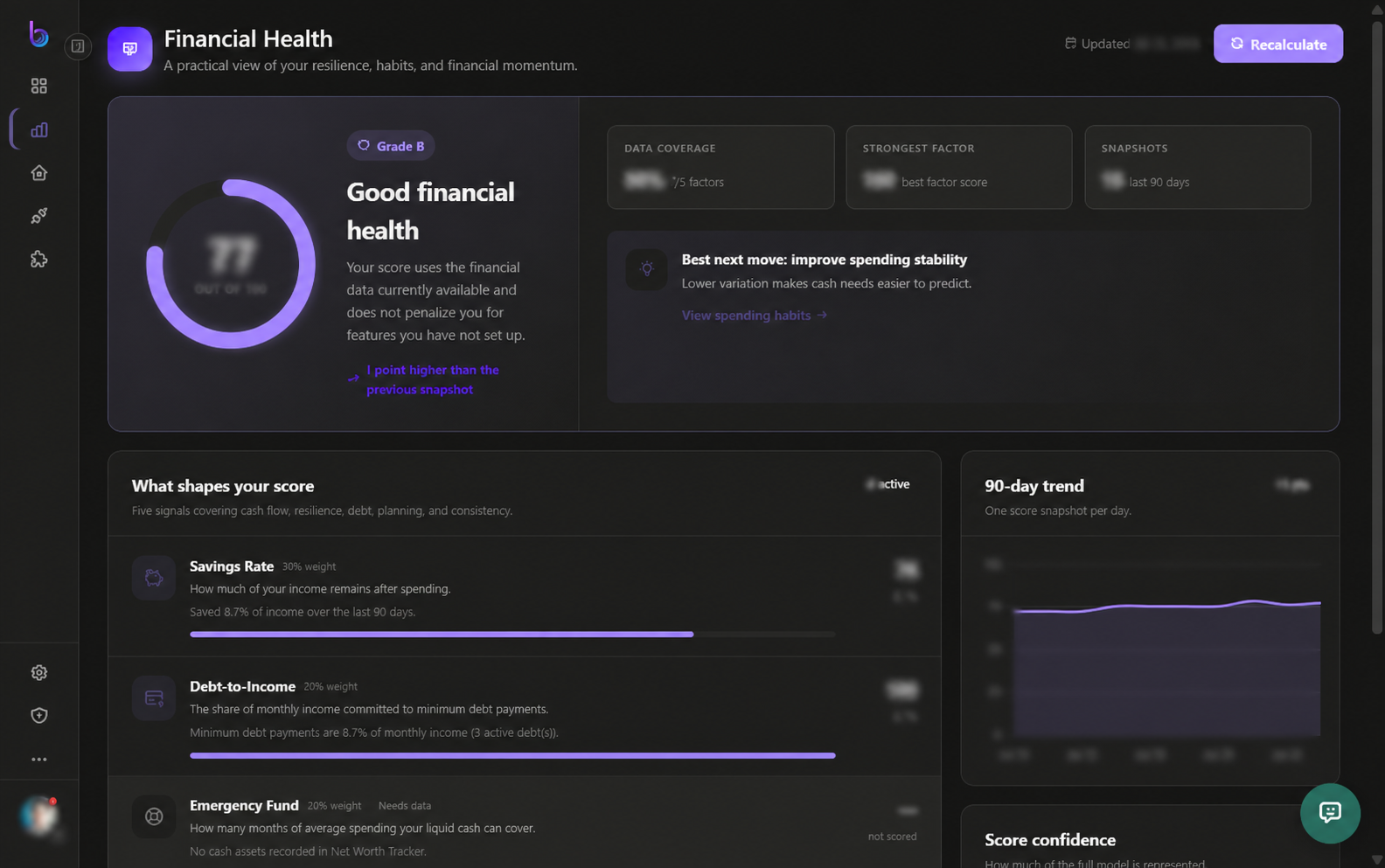
Financial Health combines multiple signals into a trend, an explanation, and practical next steps. Private metrics have been blurred.
Household scope and security
Budjit handles financial records and other private household
information, so tenancy is enforced on the server rather than inferred
from the interface. Reads and writes are scoped to the authenticated
household, protected actions require authorization and CSRF validation,
and administrative operations are denied by default.
Manual account numbers are encrypted at rest and masked by default.
Plugin actions retain the same household boundaries as the core
application. Payment, messaging, document, and settings workflows
validate ownership rather than trusting record identifiers supplied by
the browser.
Security principles
- Server-side household authorization
- Prepared database statements
- CSRF protection for state-changing requests
- Encrypted sensitive account data
- Masked values and write-only secret handling
- Explicit plugin capabilities and dependencies
- Safe failure when an optional integration is unavailable
A plugin-based household ecosystem
The plugin system lets Budjit expand without making every feature a
permanent dependency. Plugins declare versions, dependencies, routes,
migrations, and lifecycle behavior. The management workspace exposes
compatibility and operational state while preserving safeguards such as
administrator-only actions, dependency validation, and disabled-before-
uninstall enforcement.
The architecture also protects the boundary between optional features
and core tenancy. Household membership stays in the core because
budgets, accounts, expenses, and most plugins depend on it. A plugin can
own its controllers, models, services, and views without owning the
identity and authorization rules that protect the whole platform.
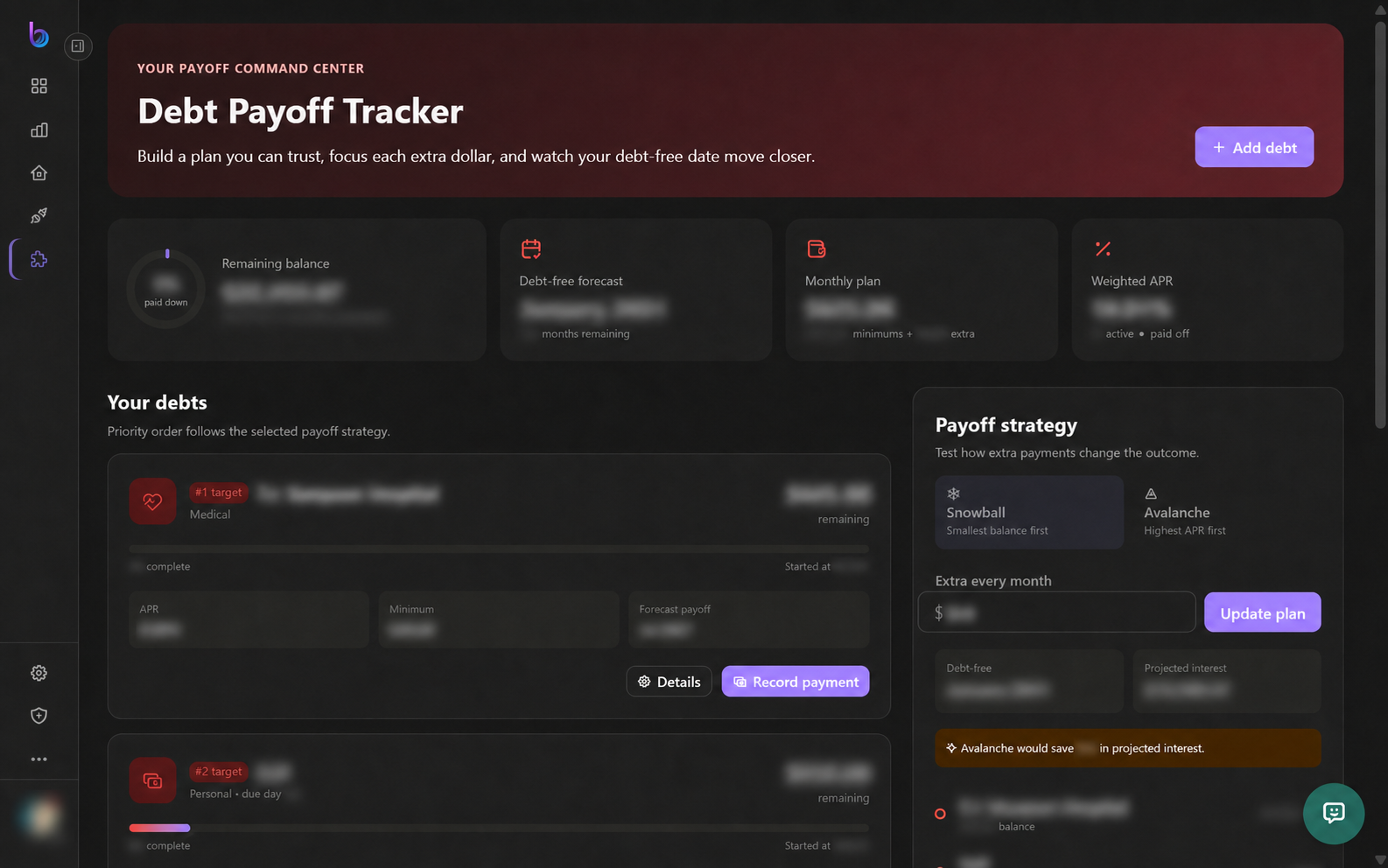
The payoff workspace compares strategies and keeps the next action close to the plan. Creditor and financial details have been blurred.
Technical foundation
Budjit is built with a deliberately understandable stack:
- PHP and MySQL on the server
- Server-rendered HTML with progressive enhancement
- Vanilla JavaScript for focused interaction
- Modular controllers, models, services, and views
- Background workers and service-health monitoring
- Responsive light and dark interface systems
- Plugin-owned migrations and version metadata
This direction favors maintainability and local ownership over a large
frontend framework or an opaque dependency chain.
AI as a calm assistant
Budjit AI is designed to support both everyday questions and advanced
operational work without taking over the product. Prompt guidance,
deterministic fallbacks, protected plugin assets, and independently
reported service health keep the experience useful even when an AI
runtime is unavailable.
The AI layer complements the application's own financial engines; it
does not replace deterministic calculations, authorization checks, or
the user's judgment.
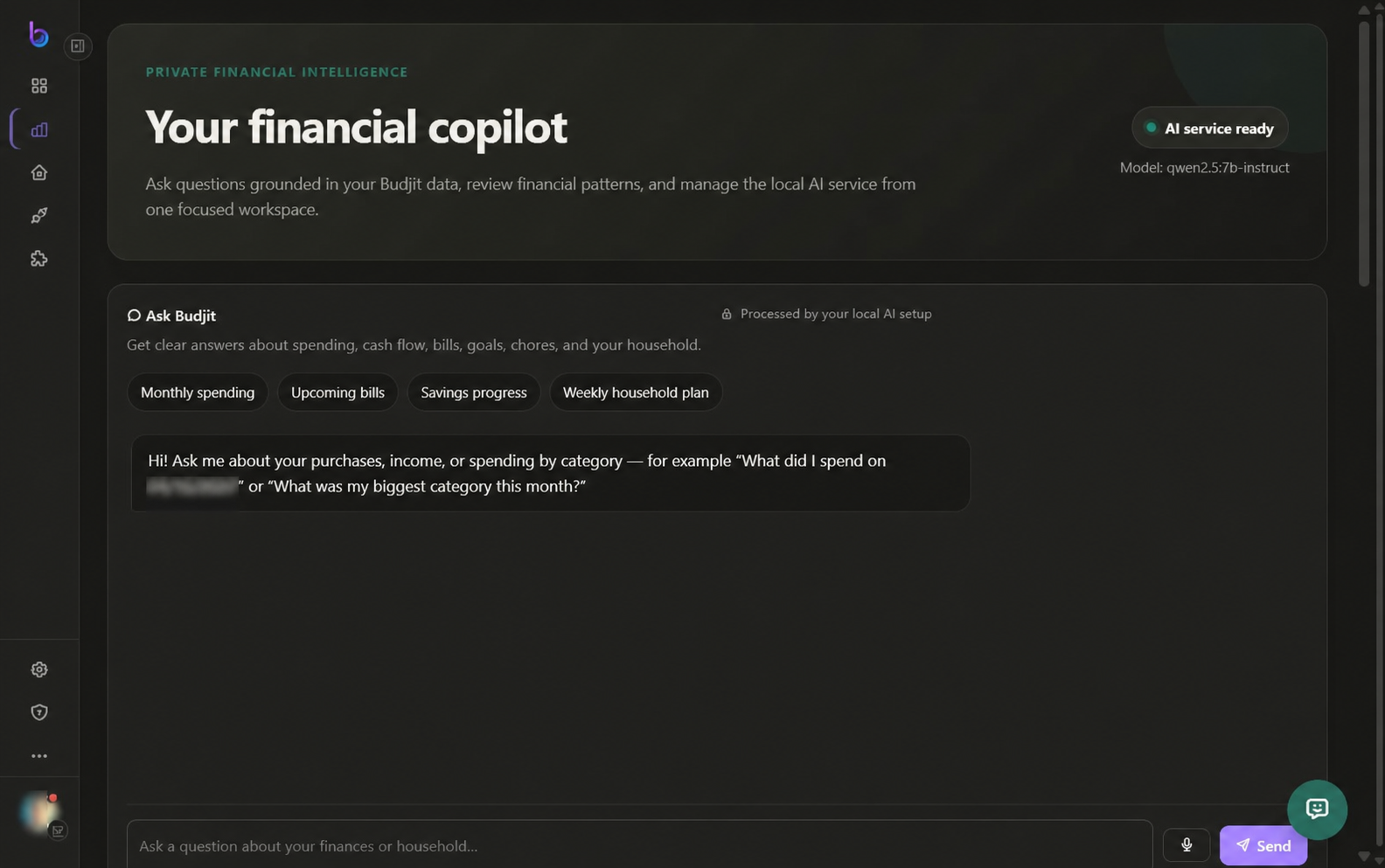
Budjit AI presents common questions as approachable starting points while keeping advanced tools available.
Outcome
Budjit now has the architecture and product language of a household
platform rather than a collection of unrelated finance screens.
Financial surfaces explain results and recommend next steps. Household
workflows share a consistent design system. Optional capabilities can
evolve as plugins while the security-critical tenancy foundation
remains stable.
The project is still evolving, but its direction is clear: one
understandable place for a household to coordinate money,
responsibilities, plans, and the information behind them.
What this project demonstrates
- Turning a narrow application into a coherent product platform
- Designing complex financial information around decisions
- Preserving security and tenancy through architectural change
- Building optional modules without weakening the core
- Creating a consistent experience across many connected workflows
- Improving an existing system in deliberate, testable phases
Next phase
Continued work focuses on deeper cross-feature insights, stronger
onboarding, clearer household coordination, integration resilience,
accessibility, and carefully chosen automation.
Budjit is not trying to become the largest household application. It is
being shaped into the most useful version of the system a real household
can understand and trust.
Use this case study as context, then describe the workflow and outcome that matter to you.
Start a conversation