PHP Config Tools: safer local configuration workflows
An authenticated local utility for controlled php.ini editing and validated Apache redirect management with backups and audit history.
Project overview
PHP Config Tools replaces two repetitive local-development chores with
focused, guarded workflows: editing selected PHP settings and managing
short Apache redirect aliases.
It is intentionally an internal utility rather than a public product.
The interface stays lightweight, but operations that change
configuration still receive authentication, validation, CSRF
protection, backups, atomic writes, and an audit trail.
Local tooling should reduce friction without turning convenience into
an unrestricted path to system configuration.
Controlled PHP settings
The settings workspace exposes only an explicit allowlist of useful
directives. Each value is normalized and validated before the configured
php.ini file can be changed.
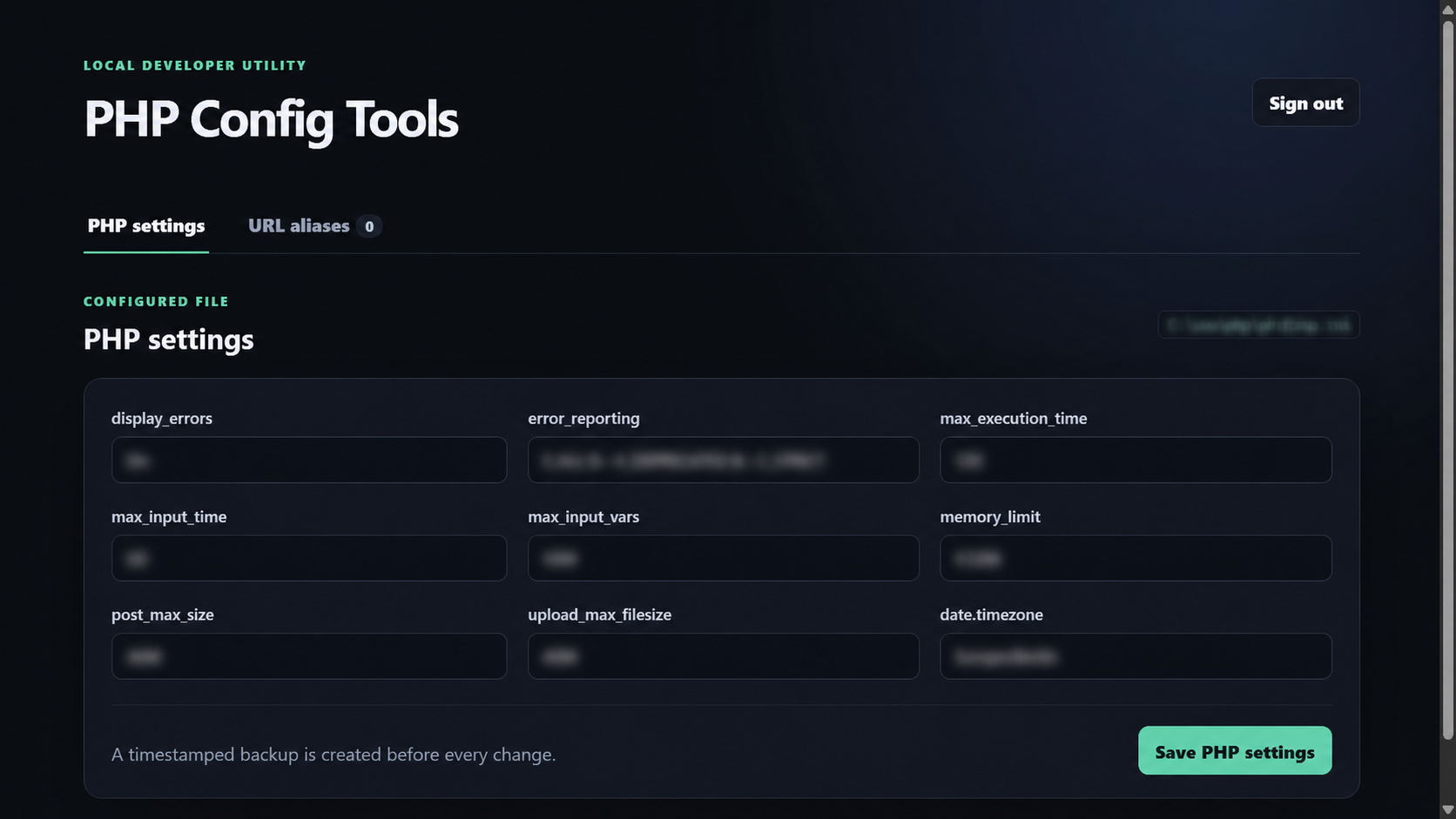
The editor presents a small, intentional configuration surface. Environment-specific paths and values have been blurred.
The service preserves comments and unrelated directives, rejects
multiline and injection-shaped values, creates a timestamped backup,
writes through a temporary file, and completes the change with an atomic
replacement.
Safety boundaries
- One explicitly configured php.ini target
- Allowlisted directive names
- Directive-specific value validation
- No arbitrary file or directive editing
- Timestamped backup before every change
- Atomic file replacement
- Authenticated, CSRF-protected requests
- Escaped output and generic user-facing failures
Local URL aliases
The alias workspace stores short source paths and HTTP or HTTPS
destinations in MySQL, then exports enabled records as standard Apache
Redirect directives.
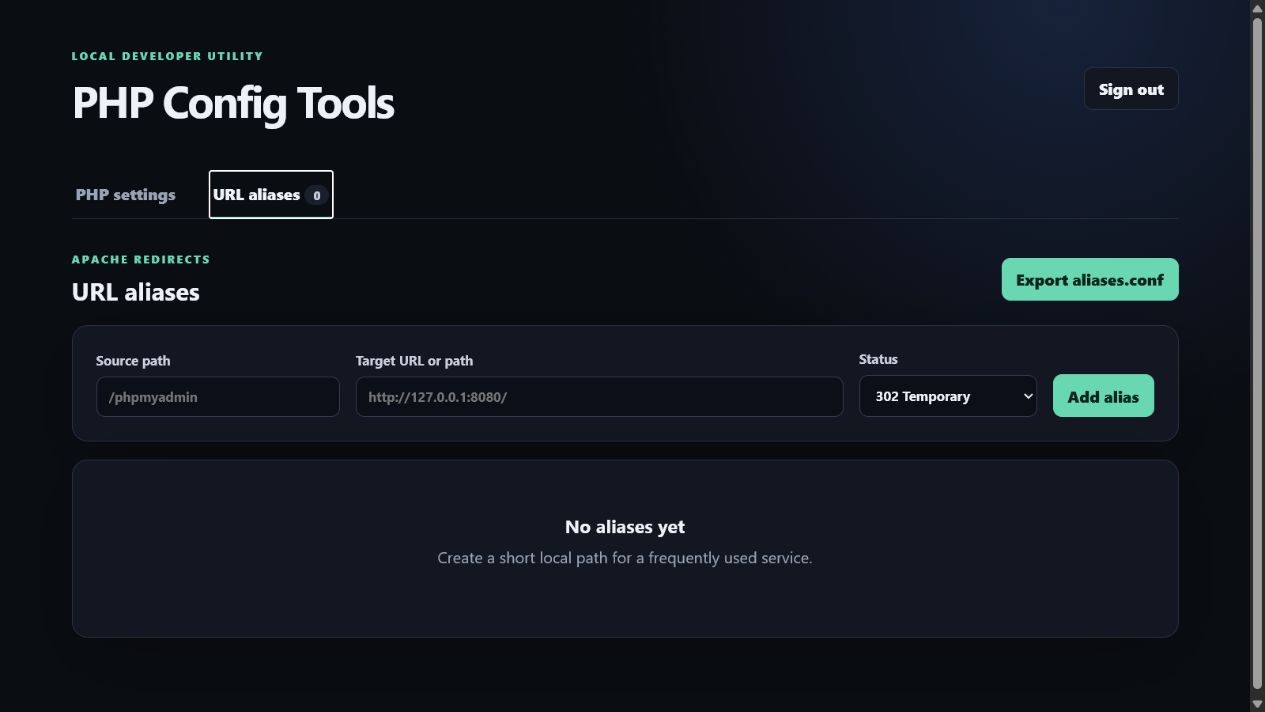
A guided empty state explains the first useful action while keeping export and status choices visible.
Inputs are data, not free-form Apache configuration. Source paths,
destination URLs, redirect status codes, and enabled state are validated
independently. The exporter writes a generated aliases.conf file
atomically so Apache never reads a partially written configuration.
Security and accountability
A local-only audience does not eliminate the need for secure defaults.
The utility uses password hashing, session inactivity handling, prepared
statements, CSRF validation, output escaping, and an audit log for
configuration and alias changes.
Database setup is handled through an idempotent update script. Repeating
the installer safely converges on the same schema, while administrator
credentials are supplied temporarily through the environment instead of
being committed to configuration.
Technical foundation
The application uses PHP, MySQL, server-rendered HTML, CSS, and focused
JavaScript. Small services separate file editing, database access,
validation, alias generation, authentication, and audit recording.
This structure keeps a compact utility understandable without collapsing
configuration-changing behavior into one large script.
Outcome
PHP Config Tools turns fragile manual edits into repeatable workflows
with clear boundaries and recovery points. It remains quick enough for
everyday local development while making the consequences of each action
visible.
What this project demonstrates
- Designing safe interfaces for configuration-changing operations
- Preserving existing files while editing allowlisted directives
- Generating server configuration from validated structured data
- Using atomic writes and automatic backups for recoverability
- Applying authentication, CSRF protection, and auditing to internal tools
- Keeping a local utility focused without sacrificing maintainability
Use this case study as context, then describe the workflow and outcome that matter to you.
Start a conversation